
Health Care and the Americans with Disabilities Act
Health Care and the Americans with Disabilities Act
The Americans with Disabilities Act (ADA) is a federal civil rights law that prohibits discrimination against people with disabilities. Health care organizations that provide services to the public are covered by the ADA.
This can be done through:
- Reasonable Modifications of Policies, Practices, and Procedures. Adjusting policies, practices, and procedures, if needed, to provide goods, services, facilities, privileges, advantages, or accommodations.
- Effective Communication. Making communication, in all forms, easily understood.
- Accessible Facilities. Ensuring physical accessibility.
Covered health care facilities include, but are not limited to: hospitals, doctors’ offices, pharmacies, dentists’ offices, acupuncturists’ offices, etc.
Health care agencies run by state and local governments are covered under Title II of the ADA. Health care organizations run by private businesses or nonprofit organizations are covered under Title III of the ADA. All places covered by the ADA must provide access to their facilities and programs for people with disabilities.
A person with a disability can be a person with a mobility or physical disability, sensory (vision or hearing), intellectual, psychiatric, or other mental disability. People with medical conditions such as HIV/AIDS, epilepsy, rheumatoid arthritis, and cancer may also covered under the ADA.
Access to health care programs and services can be met in different ways. The way a place meets its access to health care obligations will depend on who operates it – 1) a state or local government or 2) a business or nonprofit organization.
State and local governments meet access requirements to programs through “program accessibility.” This means that the program must be accessible across the system as a whole. If individual programs
within the health care system are not physically accessible, the goods and services can be relocated to an accessible location or a facility can be retrofitted to make it accessible.
Businesses and nonprofit organizations meet access requirements to programs and services by engaging in “readily achievable barrier removal” at their facilities.
Example: A private health care provider has barriers such as steps at their entrance or examination rooms that are too small to accommodate a person who uses a wheelchair. To meet their access requirements, the provider must develop a plan to remove those barriers to make the site accessible unless it is technically infeasible.
As a best practice, the provider should review its plans for barrier removal on a regular basis as it moves toward more complete accessibility of its facilities.
If a provider can demonstrate that making a reasonable modification or providing effective communication would be overly expensive (“undue financial burden”) or would completely change
the care or service provided (“fundamentally alter the nature of the service, program, or activity”) they would not be required to comply with the ADA requirements. There are a number of factors to consider before a facility can claim an undue burden or fundamental alteration of service such as the nature and cost of the action in relation to the size, resources, nature, and structure of the facility’s operation.
Example: A doctors’ office is in an existing building with 4 small exam rooms. Making all of the exam rooms accessible may not be readily achievable because load bearing walls cannot be removed or the cost of the full project may be too high. Instead, the doctor could make two of the rooms accessible and ensure they only schedule two patients who would benefit from an accessible room at the same time.
Example: A parent of a child with a disability requests to see a primary care doctor she knows. She is comfortable with this doctor and wants her to treat her child. However, this doctor specializes in care for older adults. Because the doctor is not a pediatrician, this could be a fundamental alteration of the health care service and would not be required.
Reasonable modifications of policies, practices, and procedure
Health care providers are required to make reasonable modifications (or changes) to policies, practices, and procedures to provide equal access to facilities and services to people with disabilities. The term “reasonable modification” is a broad concept that covers every type of disability.
Examples:
- Granting an early appointment to a patient with anxiety so that fewer people will be in the office and noise will be minimal.
- Allowing a companion to assist a person with a mobility disability when positioning the patient for a radiology scan.
- Modifying a policy requiring patients to complete their own paperwork, so that staff can complete intake paperwork for a person with a brain injury or dyslexia who requests the assistance to fill out the paperwork. Allowing additional time to explain care to a patient with an intellectual disability.
- Allowing a service dog that has been trained to alert their handler with a seizure disorder at the onset of a seizure to be present in an exam room.
Effective communication
Health care providers must ensure that communication with patients with hearing, vision, and speech disabilities are as effective as communication with other patients. The aid or service provided depends on the method of communication used by the patient, how long and how complex it will be, and the setting where the communication will take place.
Examples:
- For a person who is Deaf and uses sign language, providing a qualified sign language interpreter for a scheduled or non-emergency appointment.
- For a person with low vision, providing a qualified reader for written information and providing post- op discharge instructions and medication management in large print.
- For a patient with a speech disability who is not understood by clinicians on the phone, use the relay service 711 for speech-to-speech translation services.
- Digital accessibility is also required for effective communication and includes, but is not limited to: websites; medical kiosks; electronic health records; telecommunications; and telephonic health (which includes telepsychology and telemental health).
Accessible facilities
Health care facilities must ensure that their facilities are accessible to people with disabilities. When possible, medical equipment should also be accessible. Examples: accessible examination tables, accessible imaging machines, accessible scales, and patient lifts. Health care providers must have an accessible facility that meets the 2010 ADA Standards for Accessible Design and have accessible exam/ treatment/procedure rooms available.
Examples of features of accessible facilities, as defined by the 2010 ADA Standards for Accessible Design, include:
- Accessible parking spaces and entry;
- Doors with lever handles;
- Wheelchair accessible bathrooms with clear turning space, grab bars, and accessible sinks; and
- No objects that protrude more than 4 inches along the routes of travel.
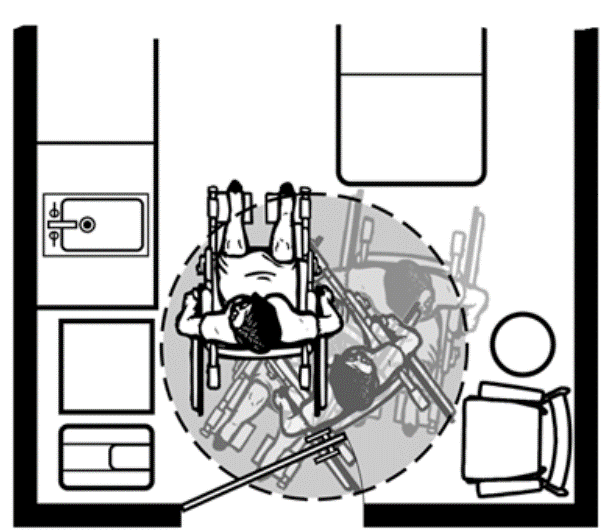
Accessible examination rooms include, for example:
- Clear pathways of travel to the rooms;
- Entry doors that meet width requirements; and
- Clear floor and turning space inside the rooms (which may be easily achieved by moving objects like a garbage can, sharps container, or a chair that is behind a door).
Need more information?
If you have questions about your rights or responsibilities under the ADA, contact your local ADA Center. Each center has ADA specialists who provide information and guidance to anyone requesting ADA information. You can call toll-free at 1-800-949-4232. You can also email your local center by completing the ADA National Network’s Email Us Form (adata.org/contact). All calls and emails are treated confidentially.
Resources on Reasonable modifications of policies, practices, and procedures:
- The ADA National Network Disability Law Handbook
- Modification of Policies, Practices and Procedures, ADA Title II
- Modification of Policies, Practices and Procedures, ADA Title III
- Understanding How to Accommodate Service Animals in Healthcare Facilities
- Additional resources can be found at /www.adapacific.org/healthcare
Resources on Effective communication:
- Communicating with People Who Are Deaf or Hard of Hearing in Hospital Settings
- Questions and Answers for Health Care Providers
- Introduction to Web Accessibility
- Guidance and Resources for Electronic Information Technology
- Additional resources can be found at www.adapacific.org/healthcare
Resources on Accessible facilities:
- 2010 ADA Standards
- Access to Medical Care for Individuals with Mobility Disabilities
- Accessible Medical Diagnostic Equipment
- Accessible Medical Examination Tables and Chairs
- Additional resources can be found at www.adapacific.org/healthcare
References and additional resources:
- ADA National Network Health Care Factsheet
- American Medical Association – Access to Care for Patients with Disabilities
- National Council on Disability, The Current State of Health Care for People with Disabilities
- New England ADA Center ADA Title II Action Guide for State and Local Governments (for more on Program Accessibility for state and local governments)
- Pacific ADA Center, Access to Healthcare and the ADA
- Pacific ADA Center, Healthcare and the ADA
- Settlement summary United Spinal Association et al. v. Beth Israel Medical Center et al.
- Southwest ADA Center, Disability Law Index – Public Accommodations (for Readily Achievable Barrier Removal for businesses and non-profits)
- US Access Board
- U.S. Department of Justice Barrier- Free Health Care Initiative
- U.S. Department of Justice Barrier The Americans with Disabilities Act and Persons with HIV/AIDS

Pacific ADA Center
1-800-949-4232 (Voice / Relay)
Local: 510-831-6714
Content was developed by the Pacific ADA Center and is based on professional consensus of ADA experts and the ADA National Network.
The contents of this factsheet were developed under a grant from the National Institute on Disability, Independent Living, and Rehabilitation Research (NIDILRR grant numbers 90DP0081 and 90DP0086). NIDILRR is a Center within the Administration for Community Living (ACL), Department of Health and Human Services (HHS). The contents of this factsheet do not necessarily represent the policy of NIDILRR, ACL, HHS, and you should not assume endorsement by the Federal Government.
© Copyright 2020 ADA National Network. All Rights Reserved.
May be reproduced and distributed freely with attribution to ADA National Network (adata.org).